

Block Jam: Cookie Master
Playful Bytes
When I want a puzzle game that I can understand immediately but still play with some care, Block Jam: Cookie Master is the kind of title I reach for. Its basic idea is simple: move blocks, bring matching colors together, and clear each puzzle. That familiar setup makes it easy to start during a short break, yet the limited space on a board can turn a seemingly obvious move into a mistake.
I reviewed it as a casual game from Playful Bytes, and my overall impression is that it succeeds by keeping the focus narrow. There is no need to learn a complicated rule set before playing. You look at the arrangement, decide what should move first, and try to create a clean path toward completion. For me, that makes it more appealing than puzzle games that bury a good central idea under too many systems.
It is free, rated for Everyone, and available for devices running Android 8.0 or later. The current version is 2.1.3. Those details make it approachable for a broad audience, although the real question is not whether it is easy to open; it is whether this particular style of puzzle matches the way you like to think.
How to decide if this block puzzle suits you
The important choice is the kind of thinking you enjoy
The first thing I consider with a casual puzzle game is whether it rewards planning or simply quick reactions. This one leans toward planning. Moving a block is not just about placing it near a matching color. The order of your moves matters, because one piece can obstruct another and leave an awkward arrangement behind.
That makes it a good fit if you enjoy looking at a board for a moment before touching the screen. I found myself checking the available routes, identifying the pieces that were most trapped, and deciding whether a convenient match would actually help later. The best move is not always the most visible match. Sometimes it is the move that preserves room for two other blocks.
Related News






That small distinction is one of the game’s strongest qualities. The rules remain friendly enough for a child or a first-time puzzle player, but the board can still encourage deliberate choices. The Everyone rating reflects that approachable presentation, while the movement puzzles give older players a reason to keep paying attention.
Why the visual idea works without overexplaining itself
The cookie theme gives the game a recognizable personality, but it does not get in the way of the puzzle. I never felt that I needed a long tutorial to understand the objective. The colors and block shapes communicate the task quickly, which is especially useful when I open the game with only a few minutes available.
This clarity also helps when handing the phone to someone else. A friend can usually understand the goal by watching one board, rather than asking for a detailed explanation of rules, controls, or character abilities. That makes it more suitable for shared casual play than games that require a long introduction.
Gallery
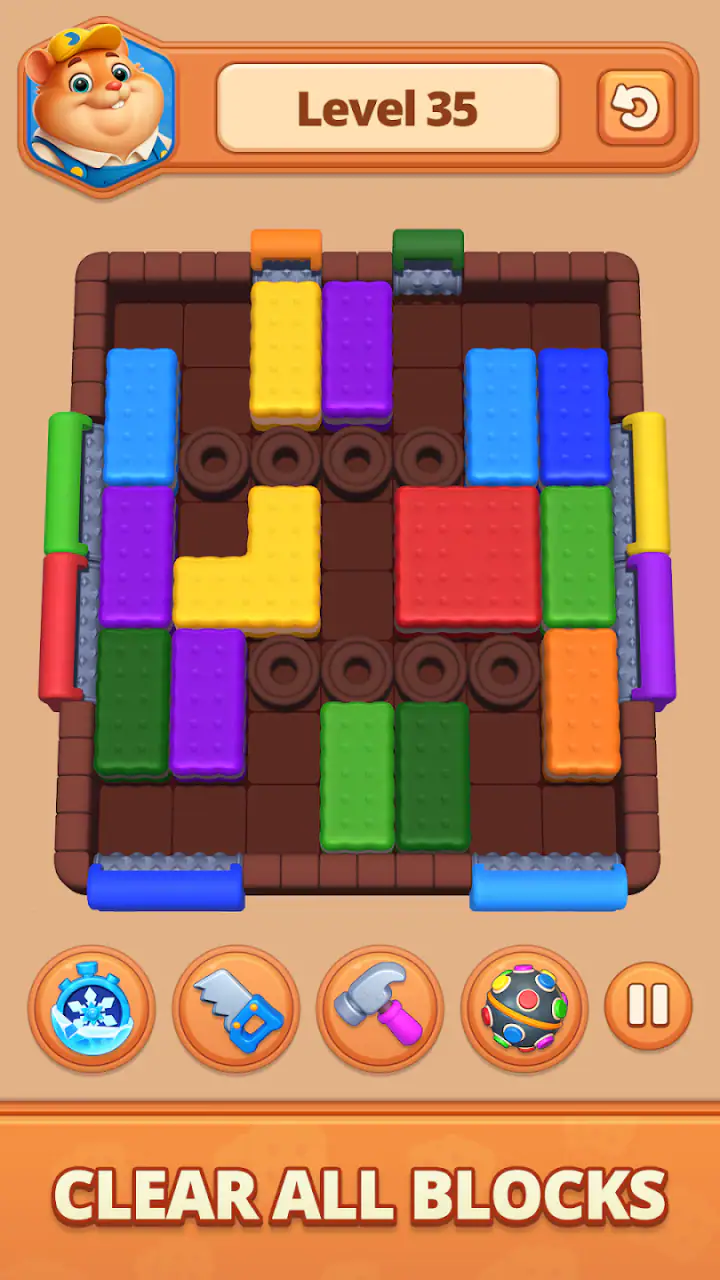
There is a trade-off, though. A focused concept can feel less exciting to players who want constant novelty. If you prefer a game built around story chapters, character progression, action, or a large collection of unrelated mini-games, the block-and-color format may feel restrained. Its appeal comes from refining one puzzle idea, not from changing direction every few minutes.
What I look for before committing to a puzzle game
I judge this type of game using four practical questions. Can I understand the objective quickly? Do the decisions matter after the first few moves? Is it comfortable to play in short sessions? And does it remain interesting without demanding the attention of a full-length game?
Block Jam: Cookie Master does well on the first and third questions. Its central task is immediately readable, and the structure suits brief sessions. The second question depends on the individual puzzle and on how much you enjoy spatial planning. If you like arranging pieces and correcting a bad sequence, it has enough friction to hold your attention. If you want fast rewards with little thought, the need to plan may feel like work.
The fourth question is where expectations matter most. I would not choose it as a replacement for a deep strategy game or a long adventure. I would choose it as a lightweight puzzle companion: something to open while waiting, relaxing, or taking a break from a more demanding activity.
A useful way to play instead of moving at random
My most useful habit was to avoid starting with the easiest-looking match. I first searched for blocks that had the fewest possible routes or that could become trapped behind another piece. Moving those early often created more working space and made the later color matches easier.
A second helpful approach is to treat open space as a resource. It is tempting to fill an available area because a block fits there, but a temporary placement can remove the room needed for a more important move. Before confirming a move, I try to imagine where the other pieces will go afterward. That extra pause is small, but it makes the game feel more like a puzzle and less like trial and error.
I also recommend using a failed arrangement as information rather than immediately repeating the same sequence. When a board goes wrong, I look for the first move that reduced my options. Reversing that decision often reveals a better order. This is a simple workflow, but it gives the game more depth than its short store summary suggests.
Where this game wins against familiar casual alternatives
Compared with match-three games, this is a more spatial experience. A match-three board often encourages scanning for combinations and reacting to the next available opportunity. Here, I spend more time thinking about movement, access, and the consequences of occupying a particular space. That difference is important if you enjoy puzzles where position matters as much as color.
Compared with word games, it asks for visual organization rather than vocabulary. I can play without searching for the right spelling or recalling a large word list. That makes it a better choice for someone who wants a puzzle that remains language-light and immediately understandable.
Compared with physics-based casual games, it feels more controlled. Success depends less on timing or unpredictable motion and more on choosing a sensible sequence. Players who dislike losing because of a difficult gesture may appreciate that emphasis. On the other hand, anyone who enjoys playful movement, surprise reactions, or fast action may find it too measured.
It also has an advantage over many larger puzzle titles in terms of mental commitment. I do not need to remember a complicated upgrade system before returning. I can focus on the board in front of me. That simplicity is a strength when I want a clean break, although it may not satisfy someone looking for a long-term collection or a highly layered progression system.
Where another category may be a better fit
If your main goal is relaxation with almost no chance of getting stuck, a more passive matching game may suit you better. Block placement can create genuine dead ends, and the need to reconsider a sequence is part of its identity. I enjoy that pressure in moderation, but it is not ideal when I want a completely effortless distraction.
If you want a competitive experience, you may prefer a puzzle category built around timed rounds, rankings, or direct challenges. The appeal here is personal problem-solving rather than comparing performance with other players. Choosing it for competition would mean accepting that its strongest moments come from solving a board cleanly, not from defeating an opponent.
Likewise, players who need a strong narrative should look elsewhere. The cookie presentation adds charm, but I would not treat this as a story-led game. Its purpose is to give me a sequence of compact spatial problems, and that focused design is more important than character development or plot.
What switching to it feels like in everyday use
Imagine waiting for an appointment with enough time for a few attempts but not enough time to start a console-style game. I can open this, inspect a board, make several careful moves, and stop when my turn arrives. The same situation works during a commute, a coffee break, or a quiet moment at home. The game’s readable objective means I can return without spending the first few minutes remembering a complicated control scheme.
The cost of switching from a different casual puzzle is mainly a change in mindset. Someone coming from a fast match-three game may initially move too quickly and overlook the importance of board space. Someone coming from a word game may need a short adjustment to think in routes and positions instead of letters. Once that habit changes, the controls feel straightforward.
There is also a practical cost for people who dislike replaying a puzzle after a poor decision. The game’s challenge is tied to sequence, so a careless opening can affect everything that follows. I see that as a fair trade for more meaningful moves, but it can be frustrating if you expect every action to be easily recoverable.
Because it is free, trying it requires little commitment. The rating sits at 4.8 from around eight hundred ratings, and the game has passed one hundred thousand installs, which suggests that its simple format has reached a substantial casual audience. I would still treat popularity as a starting point rather than a guarantee: the right choice depends on whether you want spatial planning instead of speed, story, or competition.
Small decisions that make the experience better
I found three habits especially useful. First, identify the most restricted block before chasing an obvious color match. Second, protect open lanes until you understand which pieces need them. Third, after a mistake, examine the move that caused the board to tighten rather than restarting with the same plan.
These habits also make the game a better fit for different ages. Younger players can begin by matching colors and learning that order matters. Adults can turn the same activity into a short exercise in planning ahead. If you are introducing it to someone else, I would explain the goal with one example and then let them discover the consequences of blocking a route. That is more effective than describing every possible situation in advance.
For a parent or guardian looking for an uncomplicated casual game, the Everyone rating is reassuring in broad terms, and the simple objective is easy to supervise. I would still choose play time according to the individual child, because a puzzle that is harmless in content can still become frustrating if the player dislikes being stuck.
My honest limits with the game
The narrow design is both the reason to install it and the reason some people will eventually move on. I like having one clear task, but I can also imagine wanting a different kind of challenge after a long session. The game is strongest as a focused puzzle break, not as the only game on my phone.
I would also avoid recommending it to someone who wants immediate action. The satisfying part is often the pause before a move, not the speed of tapping. Players who measure fun by rapid feedback may interpret that pause as slowness. In contrast, players who enjoy spotting a mistake before it happens will probably see it as the central pleasure.
The current version, 2.1.3, is suitable for the experience I reviewed, and the Android requirement of 8.0 or later keeps it within reach of many devices. Still, anyone using an older phone should check compatibility before planning around it. That is a practical consideration, especially when choosing a game for a shared or older device.
My recommendation for different players
I recommend it to people who want a free, approachable puzzle with a little more planning than a basic color-matching game. It is particularly good for short sessions, casual players who prefer visual tasks, and anyone who likes discovering a solution through careful ordering rather than rapid reactions.
I also think it works well as a secondary game. I can keep it alongside a word game, an action title, or a longer strategy experience and open it when I want something contained. Its value is not that it replaces every other type of entertainment; it is that it fills the quiet space between them with a clear, manageable challenge.
I would skip it if you need a story, online competition, constant action, or a large progression system. A different category will serve those needs better. I would also skip it if being temporarily stuck makes casual play feel stressful, because the game asks me to accept that some moves need reconsideration.
For everyone else, Block Jam: Cookie Master is an easy recommendation to try. Playful Bytes has built its appeal around a compact idea that is simple to explain but not completely mindless to play. I like that balance: the colors invite me in, while the block order makes me slow down and think. As a free casual game for Android 8.0 and later, it earns a place on my device when I want a puzzle that respects a short break without making the experience feel empty.
FAQs for Block Jam: Cookie Master
What is Block Jam: Cookie Master and how is the game played?
Block Jam: Cookie Master is a casual puzzle game centered on arranging and clearing colorful blocks, with a sweet cookie-themed presentation. In each level, you generally need to plan moves carefully, match or combine pieces, and remove obstacles before running out of space or moves. The early stages are easy to understand, while later puzzles require more strategic thinking and patience.
Is Block Jam: Cookie Master free to download and play?
The game can generally be downloaded and played without an upfront purchase, making it accessible to most casual players. However, free-to-play puzzle games commonly include optional advertisements, bonus rewards, or in-app purchases for extra lives, boosters, coins, or other conveniences. Before downloading, check the current store listing because pricing, advertising, and available purchases may vary by device and region.
Does Block Jam: Cookie Master require an internet connection?
Some parts of Block Jam: Cookie Master may work without a constant internet connection, which is useful when playing during travel or when your signal is unreliable. Nevertheless, an internet connection may be needed for advertisements, cloud features, event content, purchases, updates, or reward synchronization. Offline progress and functionality can also change after updates, so players should not assume every feature will remain available without internet access.
Is Block Jam: Cookie Master suitable for children and families?
The colorful graphics, simple controls, and non-violent puzzle gameplay make Block Jam: Cookie Master appear suitable for many children and family players. Parents should still review the age rating and privacy information listed in the relevant app store. Because the game may contain advertisements or optional purchases, it is also sensible to enable parental controls and require approval for transactions on a child’s device.
What should I know about ads, in-app purchases, and game progress?
Players should expect that optional purchases or advertisements may be part of the overall experience, particularly when requesting extra moves, boosters, lives, or faster progress. Spending money is not necessarily required to enjoy the puzzles, but ads can interrupt play depending on the version installed. Before changing devices or deleting the app, check whether progress is linked to an account or cloud service, since local saves may not transfer automatically.
Pros
- Simple tap-and-match controls are easy for casual players to learn.
- Short levels make it convenient to play during quick breaks.
- Colorful cookie-themed visuals give the game a cheerful
- friendly style.
- Gradual difficulty increases help introduce new mechanics at a comfortable pace.
- Offline play is useful when you have no reliable internet connection.
Cons
- Later puzzles can feel repetitive if you play for long sessions.
- Some levels rely heavily on trial and error rather than strategy.
- Limited variety in objectives may reduce long-term replay value.
- Hints or extra moves may be restricted
- slowing progress after mistakes.
- Ads can interrupt the flow between levels or during reward screens.


